Key takeaways
• Customer loyalty is one of your greatest business assets – but it’s the outcome of value, not the value itself.
• Truly persuasive B2B customer stories explain what earned trust, rather than simply claiming it exists.
• By asking deeper questions, you can uncover richer stories that appeal to journalists, prospective customers, LinkedIn algorithms, and AI-powered search alike.
Your customers trust you, but why should anyone else? That’s the question every piece of industrial customer marketing should answer. Yet it’s one many businesses unintentionally overlook.
They say they have great customer relationships, that they’re a trusted partner, and have supported a particular organisation for decades, but not why that customer stayed.
Marketing the outcome instead of the cause
Imagine a manufacturer proudly announcing it has the lowest number of warranty claims in its sector. It’s impressive, but it’s not the reason customers buy its products. The real reason might be better engineering, more rigorous testing, or tighter quality control. Low warranty claims are simply the evidence that all those things are working.
Customer relationships are exactly the same. Long-standing partnerships don’t create value of themselves; they demonstrate that value has been created consistently over time. In other words, industrial marketing often presents customer loyalty as if it were the proof when in reality, it’s the receipt.
None of this is to suggest that relationships aren’t important. Strong relationships make difficult conversations easier, encourage honest feedback, and help organisations address challenges together. But relationships are sustained by consistently delivering value, and that’s the part your communications should bring to life.
Why evidencing the creation of good relationships matters more than ever
Any business can say it has great customer relationships, but the reasons for those great relationships are what make it credible and stand out from the crowd in a proposal for a prospective new customer, in a journalist’s inbox, in a LinkedIn feed, or when AI models are choosing brands to cite. All your audiences are looking for supporting evidence, context, and something distinctive that competitors can’t offer.
That’s why expressions like ‘trusted partner’ carry less weight on their own than they might have done 20 years ago. Not because relationships matter less, but because evidence matters more.
Don’t leave people to draw their own conclusions
Proof points are often overlooked as part of everyday business
The challenge is finding this evidence. When an account manager says they have a brilliant customer relationship, they naturally skip over the hundreds of conversations, decisions, and actions that made that relationship possible.
This could be the difficult conversation that prevented a project from failing, the engineer who spotted a better solution, the service technician who answered the phone on a Friday evening, or the account manager who noticed a problem before the customer even did.
Those moments are easy to overlook and don’t feel special because they feel like everyday work but they’re precisely what earns customer loyalty and are examples that are far more persuasive than simply telling people that loyalty exists.
Climb down ‘The Loyalty Ladder’
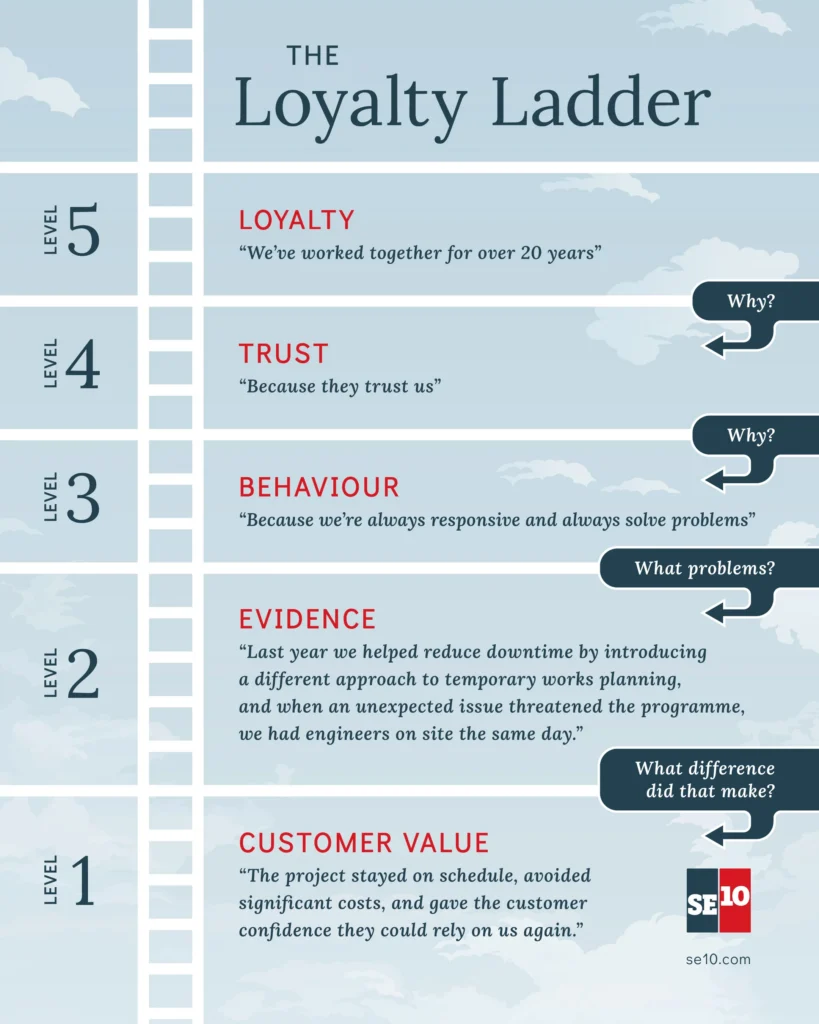
Show the behaviour, not just the badge
Some of the strongest B2B case studies never even include the words ‘trusted partner’. They begin with a challenge, reveal the thinking behind the solution, and allow the relationship to emerge naturally. That’s how we help industrial organisations unearth the stories that are already there – stories that are more persuasive because they explain not just what customers think but why they think it.
Your existing customers already know why they trust you. Your communications have one job: make sure everyone else understands it too.

Hannah Kitchener
Associate Director
About the author
Hannah is an associate director in the UK, leading strategic campaigns for industrial clients across the EMEA region. A professionally qualified journalist (NCTJ), she combines specialist sectoral knowledge in construction, energy, and materials handling with a strong network of trade media contacts to secure valuable coverage. Her expertise in inter-cultural communication, honed by degrees in modern languages and translation, is key to executing campaigns that succeed across diverse European markets.