Key takeaways
• Perspective is difficult when you’re immersed in something every single day.
• The things that need explaining aren’t always the things people realise need explaining.
• Not knowing everything isn’t a weakness. Sometimes, it’s exactly what allows you to see something everyone else has stopped noticing.
SE10 is an experienced team. This is not breaking news. Among our unit, we’ve accumulated years of expertise and knowledge across a variety of industry sectors. However, we never rest on our laurels. When we start working with a new partner, we don’t assume knowledge. We go into conversations desiring to learn, to discover, and to understand and communicate the messages imparted to us.
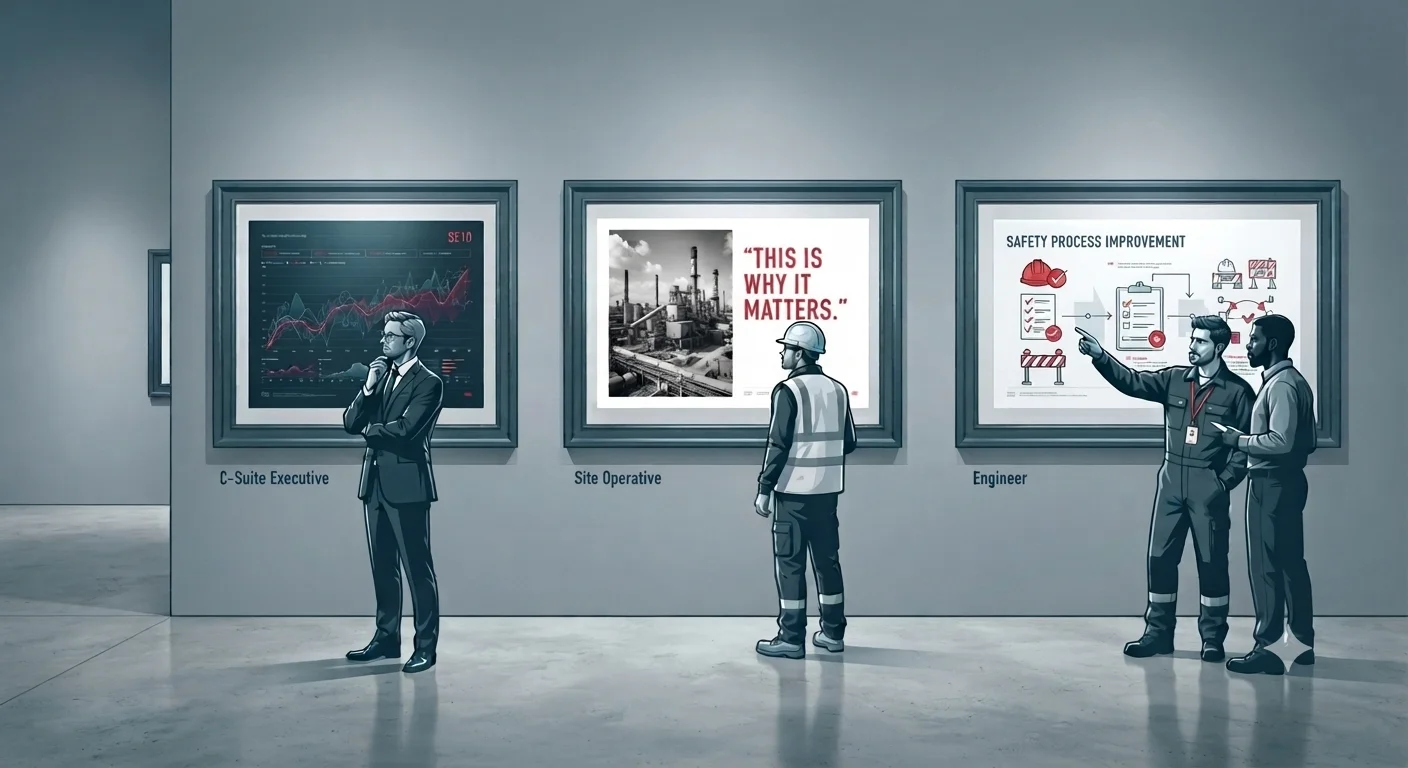
Spend enough time inside an organisation and its language, products, customers, and challenges become pretty much second nature. You know which metrics matter. You understand the industry terminology. You know why a particular product matters, which customer story carries weight, and which issues sit behind a strategic priority.
That depth of knowledge is essential to running a business well. But it can create blind spots. We’ve seen that the things obvious to the people inside an organisation often go without saying. Because there is no reason to think of something as ‘context’ when it has simply become part of how you see the world.
That is where an outside perspective can be particularly valuable.
What becomes invisible from the inside?
When I put this issue to my colleagues, one example from the SE10 team came from working with a construction equipment OEM and their dealers. From the outside, it would be easy to assume that the dealer business model was fundamentally about selling big-ticket machines. But, as our colleague discovered, the commercial reality was more nuanced.
She knew that increasing parts and service sales was a strategic priority for the client. It was only later, when she encountered the term ‘dealer absorption rate’ in an internal briefing and asked what it meant, that the importance of the aftermarket business really clicked.
The metric measures how much of a dealer’s operating costs can be covered by gross profit from parts and services. Suddenly, a strategic priority had a much bigger commercial context: aftermarket activity wasn’t simply another revenue stream. It contributed to the resilience and stability of the business when new machine sales fluctuate.
That understanding changed her communications approach, with a determination to find a genuine aftermarket angle even when working on stories about new machines.
The lesson is not that the client should have explained dealer absorption sooner. It’s that sometimes one apparently minor piece of information can reorganise your understanding of the entire business.
We should be comfortable not knowing
There is another side to this.
When I joined SE10 several years ago, one of the first clients I worked with was a heavy machinery specialist. Within a week, I was asked to interview a product manager with more than 30 years’ experience in the sector. I had only been working with the product for a few days.
Inevitably, there was a huge gap between what the product manager knew and what I knew. Some of my questions must have seemed incredibly basic to someone with such deep expertise. But asking them was essential if the resulting content was going to be accurate, accessible, and useful to an external audience.
What might initially have felt like an obvious question became the foundation for a much stronger working relationship and, for me, a lasting appreciation of the importance of being prepared to ask what everyone else in the room already knows.
That is perhaps one of the most important roles an agency can play.
Because if we are too worried about asking the basic question, we risk making assumptions. And assumptions are particularly dangerous in communications: they can leave us speaking to an audience as though it has the same knowledge as the people inside the business.
Familiar messages can hide unfamiliar opportunities
Sometimes the perspective shift comes not from discovering a new fact, but from seeing a familiar one differently.
For another of my teammates, a recurrent theme with one of their clients was the importance of preventive maintenance. Working with industrial manufacturers, she was accustomed to communicating its role in reducing unplanned downtime and protecting revenue. But familiarity can make even an important message feel abstract.
That changed when a packaging industry client shared the results achieved by one of its customers following preventive and corrective maintenance: production increased by 25% within weeks, and the investment was recouped in just 15 days.
The numbers made the business impact tangible.
Preventive maintenance was no longer simply a technical best practice or an industry talking point. It was a story about productivity, profitability, and a measurable return on investment – and that changed how my colleague viewed the communications opportunity.
Again, nothing had necessarily been missing from the original message. What changed was the perspective through which it was viewed.
The value of not sharing the same blind spots
This is why good agency relationships aren’t simply about transferring information from client to agency. They are about creating enough space for a different perspective.
Clients bring an extraordinary depth of knowledge: the history of the organisation, the nuances of the market, the realities of their customers, and the details that can take years to understand.
Agencies bring something different. We move between businesses, industries, and audiences. We have the luxury – and responsibility – of asking questions that might feel obvious, challenging familiar assumptions, and noticing details that have become invisible through repetition.
Neither perspective is complete on its own.
The strongest communications often emerge somewhere between the two: when the people who know the business inside out meet the people who are willing to say, ‘I understand that you all know this, but can you explain it to me?’
Because the things we don’t think to tell our communications agency may turn out to be the missing puzzle piece.
Not because anyone has failed to communicate them.
Simply because, when you know something deeply, it can be surprisingly difficult to remember that there was ever a time when you didn’t know it!

Jack Porter
Account Manager
About the author
Jack is an account manager based in London, UK, who joined SE10 in 2022, assisting with media coverage and campaign management for European accounts. Arriving from a background in sports writing and video content production, thoughtfulness and consideration in presentation, and networking and building strong client relationships are key skills that have transitioned easily into PR. Jack has extensive experience in interviewing knowledgeable subjects and conveying received information to a wider readership in an understandable, relatable tone.