Key takeaways
• The idea that Friday is a bad day for press release distribution is not a universal rule. It depends on the audience, industry, and story.
• SE10’s analysis of 348 industrial B2B press release distributions found that Friday achieved a 40.3% average open rate, broadly in line with Monday, Tuesday, and Thursday.
• However, Friday recorded the lowest click rate (4.9%), the highest bounce rate (22.1%), and the highest unsubscribe rate (0.20%) of any weekday.
• Wednesday emerged as the strongest overall day for B2B distribution, delivering the highest open rate (42.4%), highest click rate (7.8%), and lowest bounce rate (15.1%).
• SE10’s findings suggest that concerns about Friday releases are not entirely a myth, but the issue is engagement quality rather than visibility alone.
• More importantly, highly targeted media lists consistently outperformed large-scale distributions, highlighting that relevance often matters more than timing.
Order! Ordeerrrrrr! It’s time to settle the debate.
For decades, sending out press releases on Fridays has been seen as the ultimate PR faux pas. The logic sounds sound enough. Journalists are wrapping up for the week and may even be finishing early for the day. In some corners of communications, ‘never send on a Friday’ has become accepted wisdom.
But is it actually true? Or is the anti-Friday sentiment more industry folklore than strategic reality?
At SE10, we believe the answer is more nuanced than a blanket rule. Like most things in public relations, timing matters, but context matters more.
The traditional case against Friday press releases
The classic argument against Friday distribution usually comes down to three concerns:
1. Reduced media attention
Newsrooms are smaller than they used to be, and Fridays often operate with reduced staffing. Journalists may already be focused on preparing content scheduled for Monday.
The fear? Your carefully crafted announcement disappears into the void before anyone sees it.
2. Shorter news cycles
A release sent late Friday afternoon can quickly become ‘old news’ by Monday morning.
3. Lower internal engagement
Recent analysis by an SE10 study of 348 press release distributions found that Friday generated the lowest average click rate of any weekday, alongside the highest bounce and unsubscribe rates. This suggests recipients may be more likely to skim content rather than engage deeply with it as they prepare for the weekend.
The strategic argument for Friday press releases
Here’s where the conventional wisdom starts to crack.
1. People still open emails on Fridays
One of the most surprising findings from our analysis is that Friday’s average open rate (40.3%) was virtually identical to Monday, Tuesday, and Thursday.
In other words, journalists and media contacts are still checking their inboxes and opening press releases on Fridays. The assumption that nobody is paying attention simply isn’t supported by the data.
2. Less competition can mean more visibility
While some PR teams avoid Fridays entirely, that creates an interesting side effect: quieter inboxes.
A Thursday morning may seem ‘safer’, but it’s also one of the busiest periods for journalists receiving pitches and announcements. This is when most SE10 press releases were distributed in our study. A well-targeted Friday release can actually stand out more because there’s less noise competing for attention.
For niche industries or specialist trade media, this can be a genuine advantage.
3. Digital media never stops
The old newsroom rhythm has changed dramatically. Online publications, newsletters, podcasts, LinkedIn creators, and digital-first journalists publish continuously throughout the week.
Audiences also consume content differently now.
What industrial B2B campaign data actually says about timing
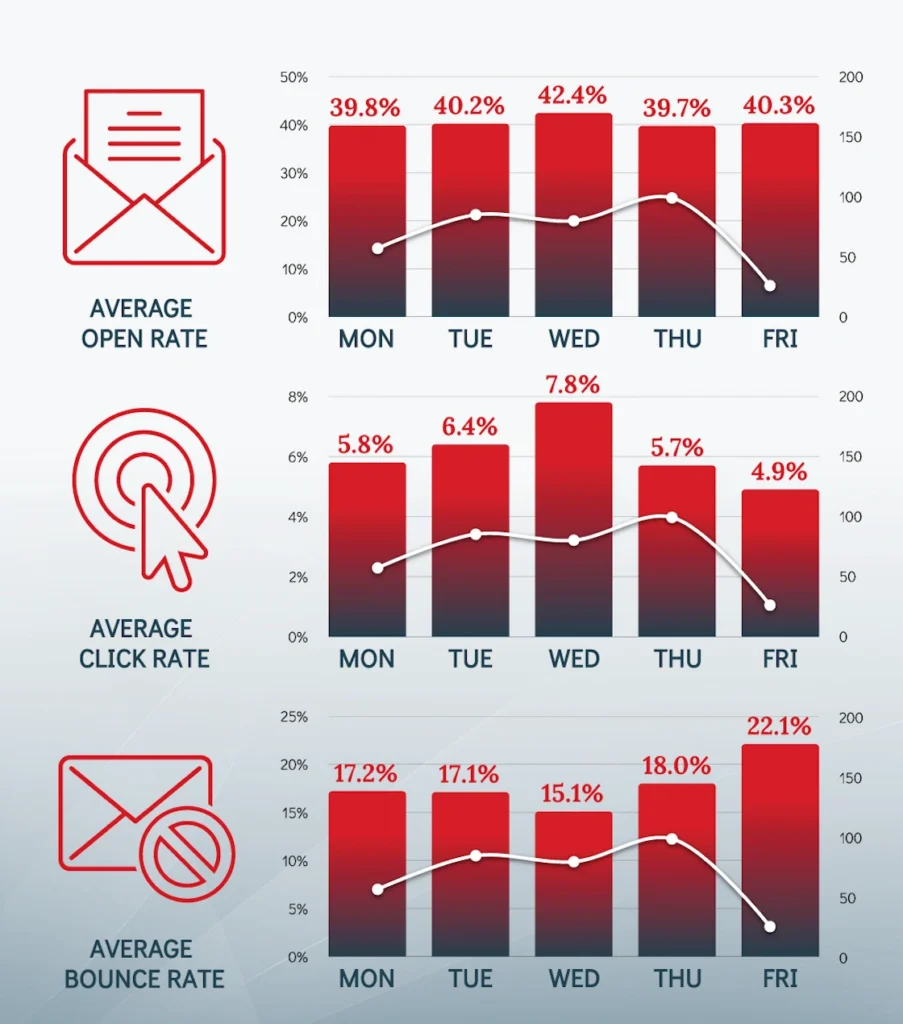
The findings paint a much more balanced picture than the traditional ‘never send on a Friday’ advice.
Wednesday emerged as the strongest overall day for press release distribution, achieving a 42.4% average open rate, a 7.8% click rate, and the lowest bounce rate of the working week. This suggests that by midweek, professional audiences have moved beyond the backlog of Monday and are more receptive to new information.
Friday, meanwhile, wasn’t the worst performer in terms of visibility. Open rates remained healthy at 40.3%, indicating that recipients were still seeing and opening content.
The challenge came after the open. Friday generated the lowest click-through rate, the highest bounce rate, and the highest unsubscribe rate of any weekday. This suggests that while journalists remain present, they may be less ready to engage with detailed content before the weekend.
Reading between the data: the hidden variables
While these numbers give us a fascinating benchmark, data without context can easily lead to PR myths. To interpret these findings, we have to take other variables into account.
• Journalist attention does not automatically generate coverage: Email and click-through rates measure broad journalist inbox behaviour, not editorial intent. An editor might open an email on a Wednesday, only to then delete it just because they are clearing their inbox. Conversely, a press release received on Friday could result in a multi-page feature published the following week.
• Our sample is highly specialised: Our dataset represents press releases primarily sent to trade journalists across the manufacturing, engineering, construction, energy, packaging, and logistics sectors. The patterns may look very different from consumer B2C media, lifestyle journalism, or national newsrooms.
• Pre-existing awareness and relationships matter: If a globally recognised market leader or a brand that already has strong media relations distributes an announcement, editors will likely open it regardless of the timestamp.
• Holidays, major exhibitions, and competitor events take journalists away from their desks: When our data shows that 90.6% of all opens came from a desktop, catching journalists while they are in the office is important. If your press release coincides with public holidays or popular vacation periods or sector specific events that it is not tied to, it can be easily overlooked.
• Strong headlines immediately help journalists see the relevance: A headline that doesn’t capture the significance of the news and why an audience should care about it will fail to capture attention no matter the day of the week.
The takeaway is that Friday isn’t automatically bad for journalist awareness, but the timing of your send is ultimately a secondary factor.
So, how do you know if Friday distribution is a bad idea?
The honest answer: sometimes, but not automatically.
The ‘never send on Friday’ rule is often too simplistic for modern industrial B2B communications. Instead, brands should ask:
Who is the audience?
What kind of media coverage are we targeting?
Is the story time-sensitive?
Does the release support wider campaign activity?
What else is happening in the industrial news cycle?
The bigger picture: relevance beats timing
Perhaps the most interesting finding from the data wasn’t about Fridays at all.
Campaigns sent to highly targeted media lists consistently outperformed large-scale distributions. Micro-lists of fewer than 50 contacts achieved open rates exceeding 50%, while campaigns sent to more than 1,000 recipients saw engagement drop significantly.
The message for PR professionals is clear: distribution quality matters more than distribution volume.
A highly relevant story delivered to the right journalist at the right publication will almost always outperform a mass-send approach, regardless of whether it lands on a Wednesday or a Friday.

Jack Porter
Account Manager
About the author
Jack is an account manager based in London, UK, who joined SE10 in 2022, assisting with media coverage and campaign management for European accounts. Arriving from a background in sports writing and video content production, thoughtfulness and consideration in presentation, and networking and building strong client relationships are key skills that have transitioned easily into PR. Jack has extensive experience in interviewing knowledgeable subjects and conveying received information to a wider readership in an understandable, relatable tone.