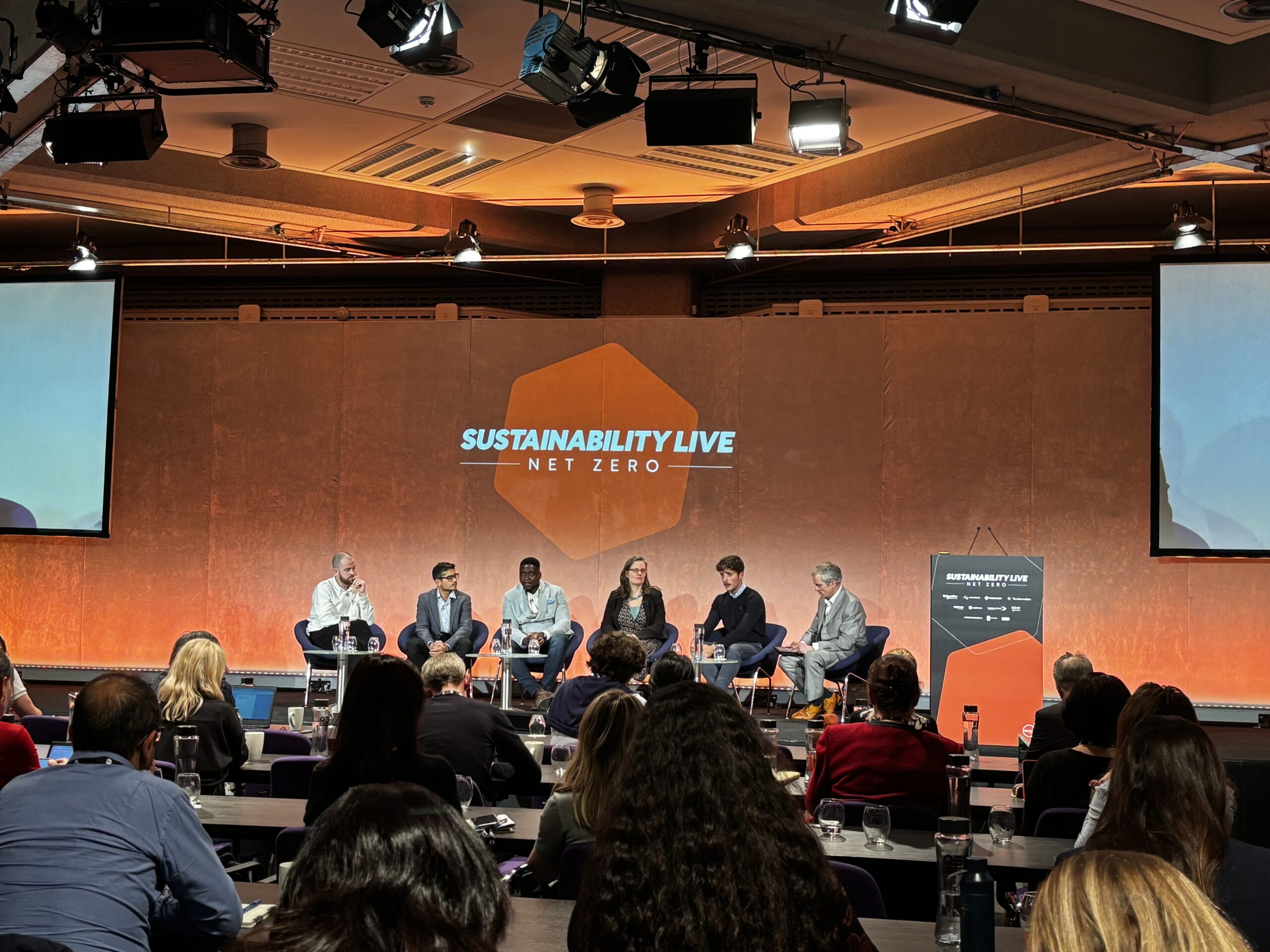
Returning to Sustainability LIVE in London, change was in the air – and the vocabulary. The era of abstract sustainability goals is over, replaced by a laser focus on tangible action, commercial value, and the specific language of decarbonisation, resilience, and nature.
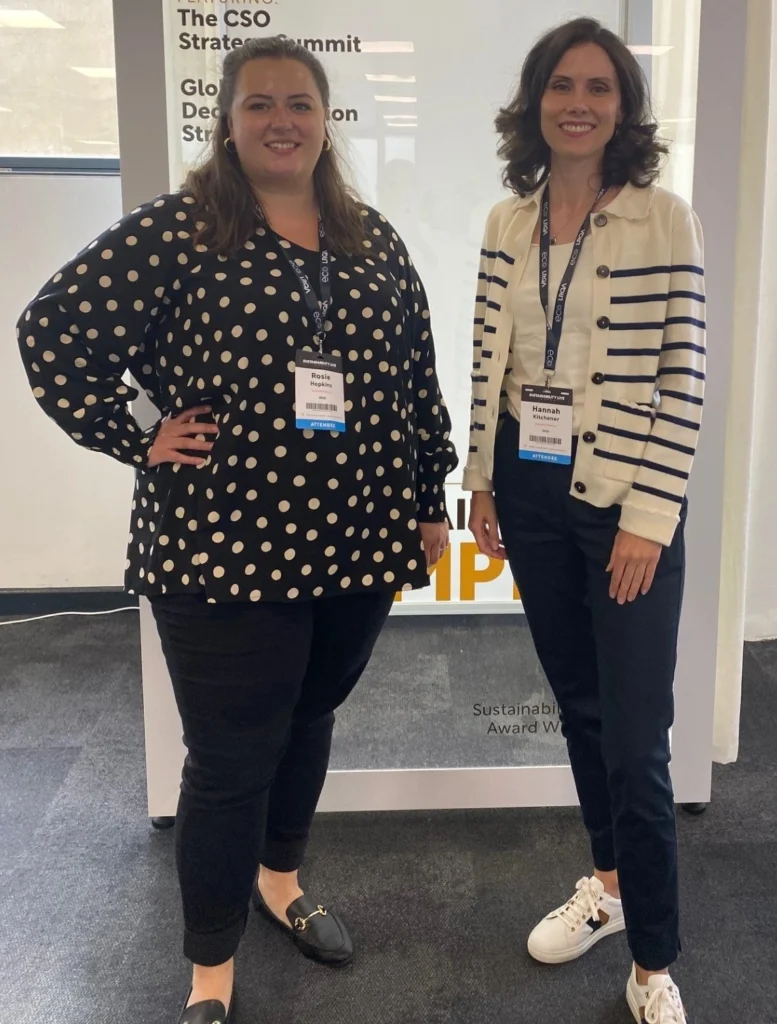
It has only been five months since my colleague Rosie Hopkins and I last attended a Sustainability LIVE event in London and even in that short time the conversation around corporate sustainability has noticeably shifted.
Back in March, many chief sustainability officers (CSOs) voiced concerns that the rollback of environmental regulation in the USA would have a chilling effect on their global work. At the same time, the EU was pressing ahead with the Corporate Sustainability Reporting Directive (CSRD), with the first group of companies impacted required to publish reports on full year 2024 data.
This week at the Sustainability LIVE London global sustainability summit, both the mood and language were more pragmatic.
Getting granular
If there were still any doubt in 2024 whether the term ESG (environment, social and governance) had fallen out of favour, this event confirmed it. The word ‘sustainability’ itself also felt less prominent. Instead, speakers were framing their strategies specifically around net zero, energy transition, decarbonisation, climate adaptation, resilience, future proofing, circularity, and nature.
This shift was reflected not only in the presentations but also in job titles, with speakers introducing themselves as head of decarbonisation strategy, head of climate change, or climate and nature lead.
From a geopolitical perspective it makes perfect sense. As we often remind our clients at SE10, communications do not stay confined to a single market – messages travel. And with regulatory landscapes diverging between the USA and Europe, many organisations appear to be choosing terminology that will resonate across borders while avoiding language that may be politically charged elsewhere.
But it isn’t just about optics. Sophie Graham, CSO at business software provider IFS pointed out that ‘sustainability’ as a word has lost much of its meaning, feeling too theoretical. The appetite now is for practicality and progress, with discussions centring on creating both short- and long-term business value, rather than abstract commitments.
Communicating progress without fear
This pragmatism was echoed by Ben Stone, group head of environmental sustainability at construction contractor Kier Group, who noted that nature projects, particularly, local initiatives, often feel more tangible and engaging for employees, customers, and communities than distant net-zero targets.
Yet, while more companies are keen to demonstrate progress, there is also a growing trend of ‘greenhushing’ – keeping quiet about environmental efforts for fear of criticism, especially accusations of ‘greenwashing’.
Annette Giardina, chief innovation and sustainability officer at IT consultancy Avanade UK&I commented that there can often be some misunderstanding of what greenwashing truly is, with genuine, measurable environmental improvements being dismissed if they are also commercially beneficial. This creates a situation, where companies fear that any action that isn’t purely altruistic will be viewed with suspicion.
It’s a challenge that must be met with clear, confident communication. The solution is not to hide the commercial benefits but to embrace them.
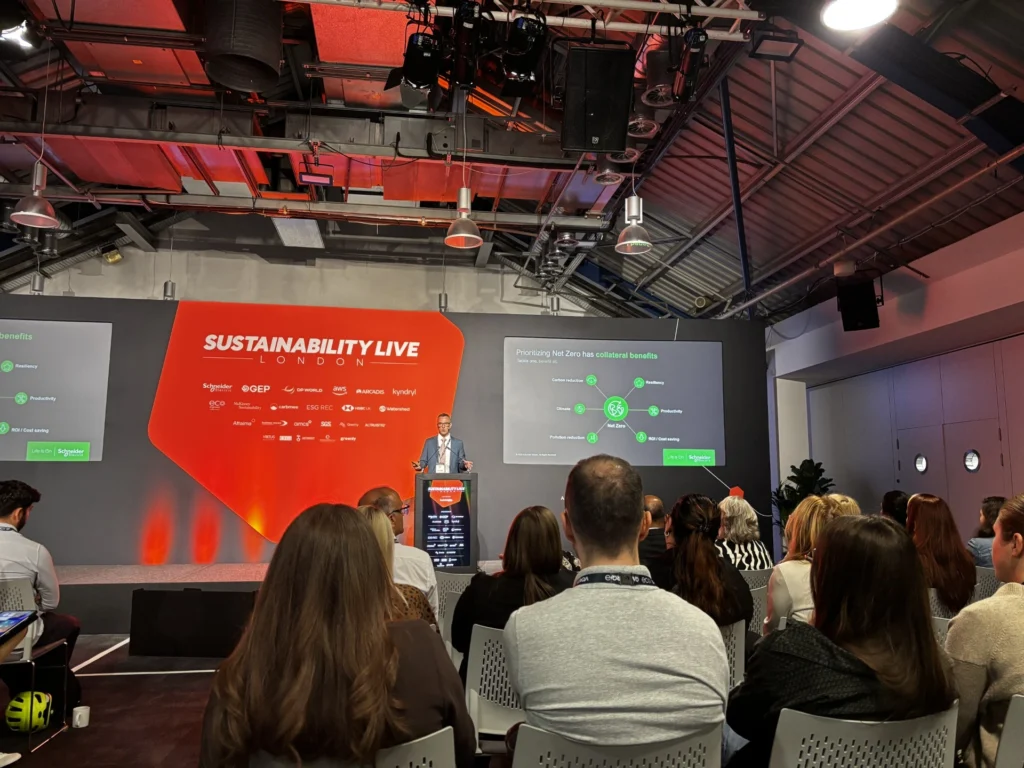
As Steve Smith, VP of global communications and thought leadership at energy management specialist Schneider Electric, put it, net-zero initiatives often deliver ‘collateral benefits’, including cost savings, productivity gains, and stronger business resilience.
In an age of intense scrutiny, the only antidote to the risk of greenwashing is detail and evidence – and the most powerful and defensible sustainability narrative is one that presents environmental and commercial benefits not as a conflict of interest, but as two sides of the same coin. These advantages should be front and centre in marketing and communications messaging.
The 4Cs of mass market adoption
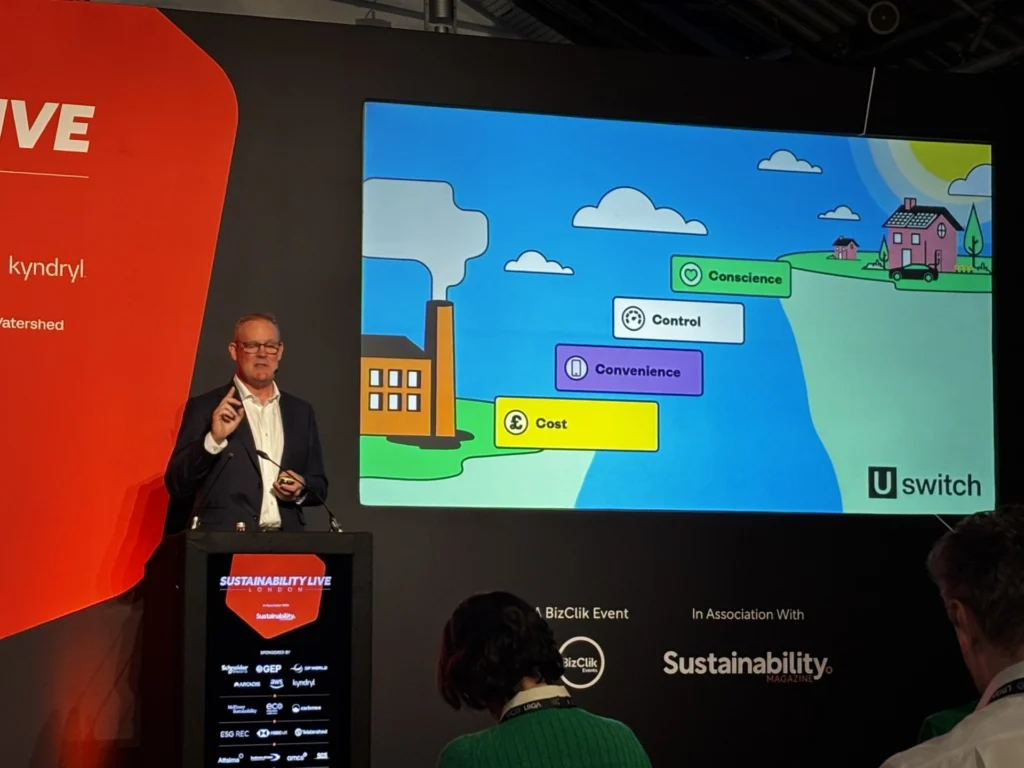
A standout keynote came from Angus McCarey, CEO of household bills comparison service Uswitch, who explored the challenge of scaling sustainability innovations from early adopters to the mass market. He stressed that too many promising solutions fail because their value is not communicated in a way that resonates with the mainstream.
Based on 25 years of consumer insight, Uswitch has distilled decision-making into the 4Cs, which must be addressed in order:
1. Cost – Solutions must save money, not add expense.
2. Convenience – They must be easy and low-effort.
3. Control – People want to choose, not be forced.
4. Conscience – Only after the first three are satisfied does social or environmental conscience kick in.
Despite drawing from B2C data, this framework can also be applied to B2B buyers because they are still people. In their personal lives, they are motivated by what is best for them and their families and it is only logical that they would apply the same pragmatic criteria at work when making high-stakes decisions about what is best for their business.
Transparency driving innovation
The importance of pragmatic messaging was also reflected in another notable theme at the event: a new and radical openness about the challenges that remain.
Several speakers acknowledged that, despite progress, their organisations still lack a clear plan for the ‘final push’ to net zero. Instead of concealing these gaps, they are beginning to collaborate – even with competitors – to share resources, invest in joint solutions, and accelerate industry-wide progress.
This highlighted how decarbonisation is a team effort, and transparency can be as powerful as results in building credibility.
Applying these lessons to industrial B2B communication
For us at SE10, this edition of Sustainability LIVE reinforced the core principles that guide our work with industrial B2B communicators:
1. Language matters – Terms such as ESG may be fading, but new language is taking its place. We stay ahead of this evolving vocabulary to ensure our clients’ brand messaging is always relevant and credible.
2. Action over ambition – Stakeholders want proof of progress. We help clients to move beyond long-term aspirations by building communication strategies that highlight clear business and community benefits.
3. Frame sustainability as value creation – The most effective sustainability stories show how doing good for the planet also delivers commercially. We help clients pinpoint the ‘collateral benefits’, such as cost savings and resilience, and position them front and centre in their messaging.
Once again, BizClik Media delivered an excellent and thought-provoking event. Rosie and I left inspired by the insights shared – and ready to help our clients sharpen their own sustainability communication strategies.
As the language of sustainability evolves, so must our communication. If you’re looking for a strategic PR partner to help you tell your sustainability story with confidence and commercial clarity, let’s start a conversation.

Hannah Kitchener
Associate Director
About the author
Hannah is an associate director in the UK, leading strategic campaigns for industrial clients across the EMEA region. A professionally qualified journalist (NCTJ), she combines specialist sectoral knowledge in construction, energy, and materials handling with a strong network of trade media contacts to secure valuable coverage. Her expertise in inter-cultural communication, honed by degrees in modern languages and translation, is key to executing campaigns that succeed across diverse European markets.