The global framework for communications measurement has been upgraded. For industrial comms leaders who need to prove C-suite value, here’s what the Barcelona Principles 4.0 mean and how to start implementing them with your agency partner.
You’ve just delivered a major communications campaign. You’ve secured coverage in key trade media, driven traffic to the website, and executed a flawless launch event. Then comes the question from the C-suite: “What was the return on this investment?”
The typical answer involves a list of activities – a clip count, social media impressions, website visits – because these are easy to quantify. But in a world of scrutinised budgets, that’s no longer enough. We need to demonstrate strategic value.
Many smart communications professionals have developed effective methods over years of practice. The goal isn’t to reinvent the wheel, but to establish a shared understanding of what ‘good’ looks like, so we can all have more productive conversations about value.
This is where a common framework such as the Barcelona Principles can help, especially since its upgrade in June 2025.
What are the Barcelona Principles?
First, a quick primer for those unfamiliar. The Barcelona Principles are a globally accepted framework of seven principles that provide the gold standard for best practice in communications measurement. They were first developed in 2010 by the industry body AMEC (the International Association for Measurement and Evaluation of Communication) to address the issue of misleading ‘vanity metrics’.
The most notorious of these is advertising value equivalent (AVE), which tries to assign a monetary value to a media clip based on what it would have cost to advertise in that space and, therefore, doesn’t actually measure the effect of the communication on an audience.
In creating the Barcelona Principles, AMEC’s goal was to create a common language and a credible methodology to quantify the impact of communications on business outcomes, not just the raw output.
What’s new in version 4.0?
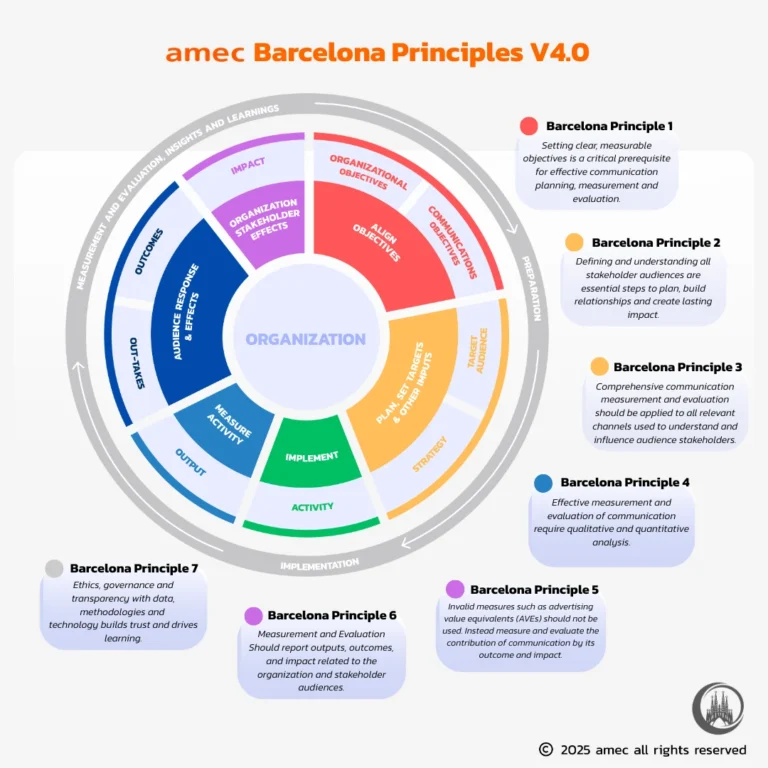
Infographic courtesy of AMEC
You can read the full Barcelona Principles 4.0 here.
The new V4.0 is described as an ‘evolution, not a revolution’. It sharpens the principles for today’s complex landscape of AI, ESG, and fragmented media. For us at SE10, three key shifts are particularly critical for our conversations with industrial B2B clients:
Insight 1: Strategy is job one.
The framework now begins by cementing a core truth: clear, measurable objectives are the prerequisite for any meaningful work. This validates a collaborative process where agency and client define the desired business impact before any work begins. For example, instead of starting with “We need a press release”, the conversation should start with “The business needs to increase market share in the renewables sector by 10% in Europe. What can communications’ measurable contribution to that goal be?”
Insight 2: Audiences are now stakeholder ecosystems.
The principles encourage a holistic view of stakeholders, moving beyond just customers. This is profoundly important for industrial companies whose success depends on a complex web of relationships. The audience isn’t just a customer, it could be a regulator in Brussels whose policy impacts factory operations, the keynote speaker at a German engineering conference who influences industry standards, the logistics partner whose efficiency is vital, or the next university talent to be hired. V4.0 now validates measuring the impact of communications on all these groups, not just on sales leads.
Insight 3: The focus is on the ‘value journey’.
The framework validates tracking the entire journey – from the outputs (the work we produce) and the out-takes (did our audience receive it?) to the outcomes (did their attitudes or behaviours shift?) and finally to the impact (the tangible effect on the organisation). Here’s an example of the value journey in action:
- Strategic objective: To be perceived as a leader in sustainable construction materials, ultimately increasing market share.
- Output: We published a detailed whitepaper on using sustainable materials in construction.
- Out-take: Did the target audience of civil engineers and architects download it and spend time reading it?
- Outcome: Do we see a subsequent increase in architects specifying our material in project plans? Were we invited to speak at a key industry event?
- Impact: Has this contributed to our strategic objective by influencing behaviour and market share?
This is a liberating concept for industrial marketers who often struggle to draw a straight line from a piece of content to a multi-million Euro sale. Given the length and complexity of sales cycles, it offers a more realistic and convincing way to demonstrate the contribution of communication over time.
Making the link to business impact
Theory is one thing; practice is another. Connecting communications work to a tangible business result requires collaboration inside your own organisation. It involves building a bridge from the outcome you create to the impact the business sees. Here are two practical examples.
Example 1: Influencing customer perception
- The goal: To shift the market’s perception of your company from being a reliable supplier to an essential innovation partner.
- The value chain: Your thought leadership campaign (output) leads to customers seeing you as more innovative (outcome). This, in turn, leads to them trusting you with larger, more strategic projects, improving your win rate and deal size (impact).
- The practical hurdle: To prove this, you need data that often lives with the sales team, such as win/loss analysis.
- Building the bridge: This is not about demanding data; it’s about forming an alliance. The conversation with your head of sales should be framed as a partnership to achieve their core objectives.
For example:
“We are running a communications campaign to build our reputation as an innovation partner. This should directly support your team’s ability to sell on value, not just price. Could we work together to analyse customer feedback from your win/loss programme? This will help us see if the messaging is working and provide you with insights on which value propositions are resonating most with customers.”
Example 2: Supporting the competition for talent
- The goal: To be seen as the employer of choice for skilled engineers.
- The value chain: Your employer branding campaign (output) leads to potential hires seeing you as a more exciting and rewarding place to work (outcome). This leads to better candidates applying and accepting offers, reducing recruitment costs and time-to-hire (impact).
- The practical hurdle: Proving this requires data on cost-per-hire and offer acceptance rates, which lives exclusively within HR.
- Building the bridge: Approach your HR lead with a solution to their problems, not a request for data and position yourself as a strategic partner in their success.
- For example:
“I know the competition for skilled engineers is one of our biggest business challenges. Our communications work is specifically designed to make us a more attractive employer. If we partner to track metrics like offer acceptance rates and cost-per-hire, we can build a powerful, joint report for the C-suite that shows how our departments are collaborating to solve this critical business problem.”
Making this a reality
At SE10, we understand the reality of the modern communications role and how it is constantly evolving. Our clients are often stretched thin, juggling multiple priorities and when we talk about building alliances with sales and HR to get data, it could feel like we’re adding another task to an already overflowing to-do list.
So let us be clear: our role as your agency partner is to take on the burden of this process for you.
Proving the value of our collective work shouldn’t be another problem for you to solve. It’s a service we provide. We do the prep work, we draft the communications, we handle the analysis, and we build the report. You can help us as the champion and the door-opener, and we’ll do the heavy lifting that makes you, your department, and our partnership look great.
The ultimate aim of this measurement process is to transform the communications function itself from being perceived as a cost centre to being recognised as a strategic growth engine for the entire business.
When you, our client and partner, can walk into a leadership meeting armed with a dashboard showing a credible correlation between your communications strategy and a reduction in cost-per-hire, for example, two things happen.
- You are no longer just talking about communications; you are speaking the language of the C-suite. You are talking about talent acquisition, sales growth, and operational efficiency. This is how you earn and retain a seat at the strategic leadership table.
- You become an indispensable hub of cross-functional intelligence. By building alliances with sales and HR, you gain a unique understanding of customer pain points and recruitment challenges, enabling you to create even more resonant and effective campaigns in the future.
In a climate of tight budgets, the functions that can prove their contribution to business goals will be the ones that are protected and invested in. This is the evidence you need to defend and grow your own team and budget and strategic role within the company.
Navigating internal roadblocks
We must also be practical, however. In a perfect world, every department would be perfectly aligned but your colleagues in sales and HR are busy with their own priorities. What happens if, despite your best efforts to build a partnership, the internal data you need to prove business impact still remains out of reach?
This is not a failure; it is a common challenge. When this happens, our measurement strategy pivots. If we cannot directly measure the final business impact, we must measure the preceding audience outcomes as thoroughly as we can.
The goal is to build a case so strong that the link to business value becomes a credible and logical inference. For example, if we can’t access sales data, we can prove that our content led to a 50% increase in downloads of technical whitepapers by engineers from target customer accounts. If we can’t access HR data, we can prove through direct surveys that our campaign shifted the perception of our company among the exact talent pool they are trying to hire.
By building an undeniable case that you have changed the attitude and awareness of your target audience, you create a powerful, inferred link to the business impacts that logically follow – even if you can’t access the final internal report. It’s about demonstrating your influence on the things you can control, thereby building the strongest possible case for your contribution to the things you can’t.
A collaborative way forward
No framework is a silver bullet, and measurement is a discipline that is constantly evolving. We don’t have all the answers, and we are on the same learning journey as our clients.
But by using shared tools such as the Barcelona Principles, we can ensure we are asking the right questions together. It helps us move the conversation beyond activity and toward impact, fostering a true partnership focused on delivering and proving the value that great communications can bring to a business.
Let’s talk measurement. Schedule a complimentary 30-minute session with our team to discuss how your current measurement framework aligns with these principles.

Hannah Kitchener
Associate Director
About the author
Hannah is an associate director in the UK, leading strategic campaigns for industrial clients across the EMEA region. A professionally qualified journalist (NCTJ), she combines specialist sectoral knowledge in construction, energy, and materials handling with a strong network of trade media contacts to secure valuable coverage. Her expertise in inter-cultural communication, honed by degrees in modern languages and translation, is key to executing campaigns that succeed across diverse European markets.